

Manuals of product LP200

Editorial note
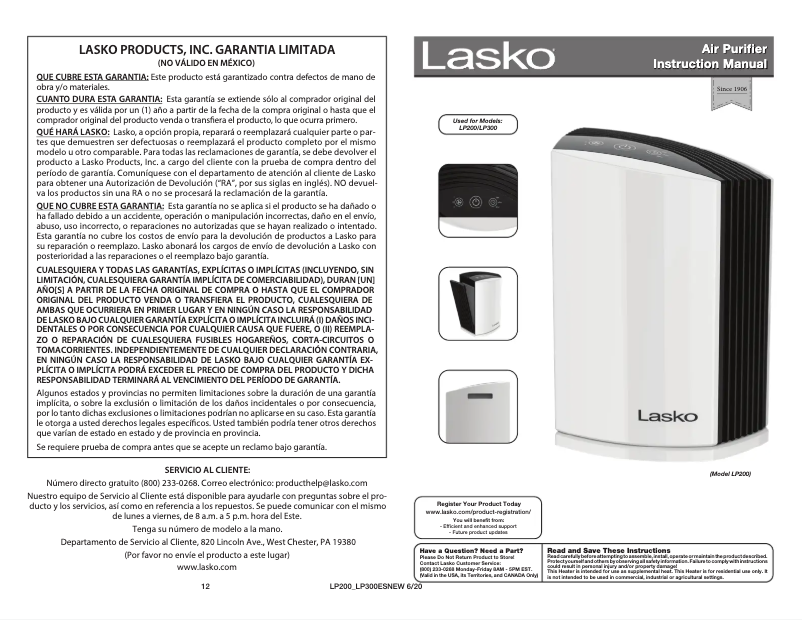
The Lasko LP200 air purifier stands out for its optimal performance and compact design, allowing it to easily fit into various spaces. The Lasko brand, known for its innovation and reliability, ensures high quality that contributes to a satisfying user experience. The intuitive features of the device make it accessible, which is a major advantage for users. However, some drawbacks must be taken into consideration. The noise generated during its operation can disrupt daily activities or sleep, particularly in quiet environments. Additionally, its effectiveness may decrease in larger rooms, thus limiting its optimal use. The cost of replacement filters can also accumulate over time, representing an additional investment for the maintenance of the device. In terms of documentation, the Lasko LP200 benefits from excellent clarity, with a user manual and maintenance guide that facilitate installation and use. However, the lack of smart connectivity may disappoint some users wishing to integrate their purifier into a modern home automation system. In summary, the Lasko LP200 is a quality purifier that offers a satisfying user experience, although it has some limitations regarding noise and efficiency in larger spaces.Score details
User experience
The user experience is very satisfactory thanks to intuitive features that make the purifier accessible to everyone. However, the noise during operation can detract from the experience in quiet environments.
Performance
The air purification performance is optimal for medium-sized spaces, but may be limited in larger rooms, which can affect its effectiveness.
Documentation
The documentation is comprehensive, including a user manual and a maintenance manual, making the installation and use of the device easier.
Design
The design of the Lasko LP200 is compact and stylish, allowing it to easily fit into various spaces without compromising its effectiveness.
Value for money
Although the purifier is of high quality, the cost of replacing filters can represent an additional investment over time.
Features
The Lasko LP200 does not offer smart connectivity, which limits its integration into modern smart home systems and may disappoint some users.
Advantages
Air purifier from a recognized brand
Optimal performance for clean air
Complete documentation for easy installation
Compact and elegant design
Intuitive and accessible use
Disadvantages
Relatively noisy in operation
Limited efficiency in large rooms
High cost of replacement filters
Can be bulky in small spaces
No smart connectivity
Technical Specifications LP200
General Information
-
ModelLP200
-
Brand
-
Category
-
Type
-
SKU1664214
-
MPN1664214
Frequently Asked Questions
Is the Lasko LP200 manual available in French?
Similar products


More product categories from brand Lasko
More product types from brand Lasko


Presentation of product LP200 specifications from brand Lasko
General Information
The Lasko LP200 air purifier, designed by the renowned brand Lasko, stands out for its commitment to innovation and quality in the field of household appliances. This model, identified by the EAN code 0046013458483, offers effective air purification performance, thus contributing to a healthier indoor environment. Its compact and elegant design allows it to harmoniously fit into various spaces while optimizing its functionality.
Advantages
The Lasko LP200 is a high-quality air purifier designed to enhance the user experience by ensuring cleaner and healthier air. It comes with comprehensive documentation, including a user manual and a maintenance guide, making its installation and use easier. Thanks to its intuitive features, this device is accessible to everyone, making its use simple and enjoyable.
Disadvantages
However, the Lasko LP200 has some drawbacks. Its operation can be relatively noisy, which could disrupt daily activities or sleep in quiet environments. Additionally, its purification efficiency may vary depending on room size, limiting its use in large spaces. The cost of replacement filters can accumulate over time, representing an additional maintenance cost. Finally, the lack of smart connectivity may restrict its integration into modern home automation systems.


